
If you’ve ever sat at your desk at 2:00 AM with three empty energy drinks and a 15-page research paper due in six hours, you know the specific kind of panic that APA formatting induces. You finally finished the “meat” of your paper—the actual research—but now you’re staring at two sections that feel exactly the same: the Abstract and the Introduction. Are they the same thing? Do you just copy-paste the intro into the abstract box? (Spoiler alert: No, please don’t do that).
High school seniors and college freshmen in the US often find themselves in a tailspin trying to figure out where one ends and the other begins. Between managing a high GPA and trying to figure out college admissions, the last thing you need is a point deduction because your abstract looked like a trailer for a movie that never started. If the stress of formatting is getting to you, seeking professional essay help from a trusted platform like myassignmenthelp can ensure your citations and structure are spot-on, letting you focus on the actual content.
The “TL;DR” vs. The “Hook”: Understanding the Difference
Before we dive into the mistakes, let’s clear up the confusion. Think of your research paper like a movie.
- The Abstract is the IMDb blurb. It tells the viewer the plot, the stars, the ending, and whether it’s a comedy or a drama in about three sentences. It’s for the person who wants to know if the movie is worth their time before they buy a ticket.
- The Introduction is the opening scene of the movie. It sets the mood, introduces the conflict, and makes the audience want to keep watching. It doesn’t tell you the ending; it makes you crave the ending.
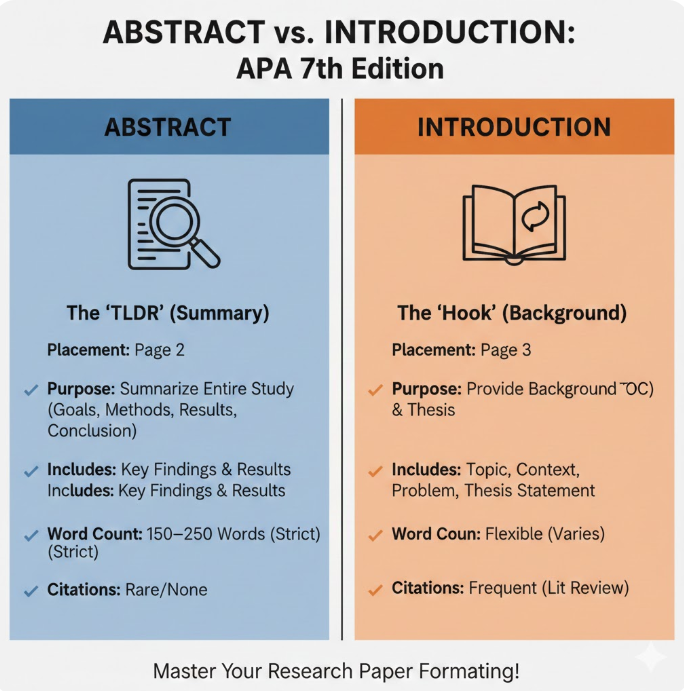
In academic terms, the Abstract is a self-contained summary of the entire paper (including results), while the Introduction is the first section of the actual body of the paper that leads into your thesis.
| Feature | Abstract | Introduction |
| Placement | Page 2 (immediately after Title Page) | Page 3 (or after Table of Contents) |
| Purpose | To summarize the entire study briefly | To provide background and state the thesis |
| Includes Results? | Yes, always | No, usually saved for the end of the paper |
| Word Count | Strict (150–250 words) | Flexible (depends on paper length) |
| Citations | Rarely used (must be self-contained) | Frequently used to support background |
Why Students Struggle with APA 7th Edition
The American Psychological Association (APA) updated its guidelines to the 7th Edition a few years ago, and while it made some things easier (like removing the “Running head” for student papers), it added nuance to how we present information. Students often fall into the trap of being too “wordy.” In an American classroom, your teacher isn’t just grading your ideas; they are grading your ability to follow a professional rubric.
Writing a technical summary is a skill that takes practice. If you are struggling with the specific “how-to” of this process, there are great guides available on how to write an apa abstract that break down the sentence-by-sentence requirements for a perfect grade.
Now, let’s look at the five most common traps that lead to point deductions.
1. The “Copy-Paste” Catastrophe
The single most common mistake is using the Introduction as the Abstract. It’s tempting, right? You already wrote a great opening paragraph that explains your topic perfectly. Why not just put it on Page 2 and call it a day?
The Reality: The Introduction is meant to be the “opening act.” It builds the case for why your research matters. It often ends with a thesis statement or a research question. However, an Abstract must include the “Method” and the “Results.” If your Abstract doesn’t tell the reader what you found in your study, it isn’t an Abstract—it’s just a duplicate intro.
How to Fix It: When writing your Abstract, look at your Conclusion. Take the “answer” to your research and move it to the front. The reader should be able to read your Abstract and know exactly what happened in the experiment without ever turning the page.
2. The Word Count “Over-Flow”
Most US professors and academic journals follow a strict 250-word limit for Abstracts. In the world of APA, “concise” is the golden rule. Students often try to include every detail of their methodology or list every single source they cited.
The Reality: If your Abstract is 400 words long, you’ve essentially written a mini-essay. This shows the instructor that you can’t distinguish between “crucial info” and “extra details.”
Pro-Tip for 12th Graders: * Sentence 1: The problem/goal.
- Sentence 2: The participants/data source.
- Sentence 3: The main method used.
- Sentence 4: The key finding.
- Sentence 5: The “so what?” (Conclusion).
If you hit these five points, you’ll usually land right around 200 words.
3. Formatting Fails: The “Abstract” Label
You would think that labeling a page would be the easy part, but APA has very specific rules about how the word “Abstract” should look.
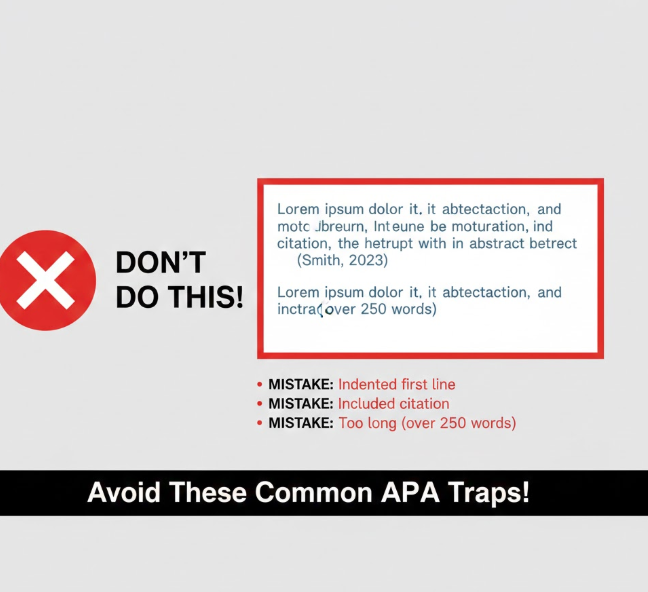
The Reality: Many students either forget to bold the word, or they indent the first line of the Abstract paragraph like they would in a normal essay.
- Mistake A: Writing “Abstract” in regular text.
- Mistake B: Indenting the paragraph.
The Fix: 1. The word Abstract should be centered and bolded at the top of the page.
2. The paragraph itself should not be indented. It should be a single, double-spaced block of text flush with the left margin. This is one of the only times in an APA paper where you don’t hit the “Tab” key at the start of a paragraph.
4. Keyword Chaos
At the bottom of an Abstract, you’re usually required to list “Keywords.” These are the terms a researcher would type into Google or a library database to find your paper.
The Reality: Students often treat this like a hashtag list on Instagram. They use too many, they don’t format them right, or they capitalize every single word.
The APA Way:
- Indent the line (0.5 inches).
- Italicize the word Keywords: followed by a colon.
- List your 3–5 words in lowercase (unless they are proper nouns).
- Do not put a period at the end of the list.
5. Citation Overload in the Abstract
In your Introduction, you want to cite people. You want to show that you’ve done your homework and know what other experts are saying. However, the Abstract is about your work.
The Reality: Including “According to Smith (2024)…” in your Abstract is generally a no-go. The Abstract is supposed to be a “stand-alone” document. If someone reads your Abstract in a database, they might not have access to your full reference list yet.
The Fix: Save the citations for Page 3 (the Introduction). Use the Abstract to describe your own findings and your own process. If your entire paper is a critique of one specific author, you can mention them by name, but avoid the standard (Author, Year) parenthetical citations that clutter the flow of a summary.
Practical Checklist for Your Next Paper
Before you hit “Submit” on that final draft, run through this quick US-style checklist to see if you’ve separated your Abstract and Introduction correctly.
- Check the Header: Does Page 2 have the bolded title Abstract?
- Check the Flow: Does the Abstract tell me the results? Does the Introduction tell me the background?
- Check the Indents: Is the Abstract paragraph flush-left? Is the Introduction paragraph indented 0.5 inches?
- Check the “Keywords”: Is the word Keywords: italicized and indented?
- Check the Tense: Use the past tense for what you did (e.g., “The study analyzed…”) and the present tense for what the data means (e.g., “The results suggest…”).
Final Thoughts for Students
Mastering APA formatting is less about “being a genius” and more about being a “perfectionist for the rules.” In the US education system, following these guidelines shows your professor that you respect the academic process. It makes your work look professional, credible, and ready for a higher-level audience.
The Introduction gets the reader in the door, but the Abstract is what lets them know if they’re in the right building. Keep them distinct, keep them clean, and don’t be afraid to ask for a second pair of eyes to check your margins.
Frequently Asked Questions
1. Can I use the same text for my Abstract and Introduction?
No. Your Abstract is a summary of the entire paper, including the results, while the Introduction only introduces the topic and thesis.
2. Is the Abstract paragraph indented in APA 7th Edition?
No. Unlike standard paragraphs, the Abstract should be a single block of text flush with the left margin (no indentation).
3. What is the word count limit for an APA Abstract?
Typically, an APA Abstract should be between 150 and 250 words. It needs to be concise while still covering your research goal, method, findings, and conclusion.
4. Do I need to include citations in my Abstract?
Generally, no. The Abstract should be a “stand-alone” summary of your own work. Save your external citations for the Introduction and Body paragraphs