
In competitive markets, brand positioning isn’t primarily a communications exercise. It’s the aggregate of a company’s actual choices — what it builds, what it charges, what it promises, how it behaves when something goes wrong — accumulated into an impression that the market forms independently of whatever the company claims about itself.
A gaming portal can describe itself as player-focused, trustworthy, and feature-rich. Whether the market believes it depends entirely on whether the behavior behind those descriptions holds up. Players who have used multiple portals develop a finely tuned sense for the gap between a portal’s claimed positioning and its actual one — and they share that calibration in the community channels where portal reputations are actually formed.
Hitclub is a reward gaming portal that has developed a market position through product behavior rather than marketing language. Understanding where Hitclub sits in the competitive landscape — and how it got there — requires looking at the signals the portal sends through its actual choices.
GO88 occupies a comparable position in the same market, having built its brand identity through similar means: consistent product behavior, reliable financial conduct, and a game library built for the audience it actually serves. Hitclub has pursued its own version of this identity, with a positioning that is now distinct enough to be read clearly from the outside.
The Product That Defines the Position
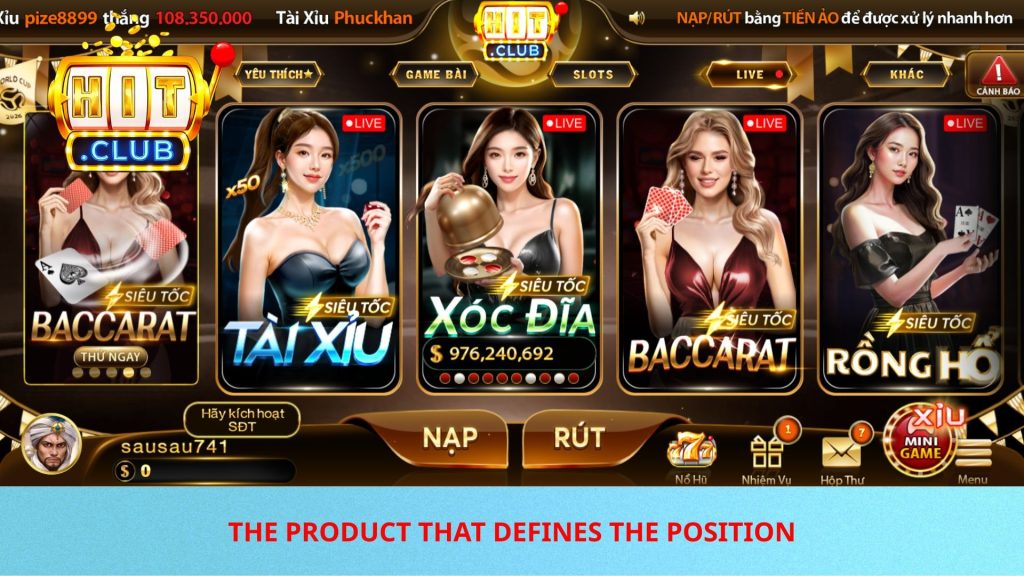
Hitclub’s game portal runs across 4 categories: card games (Tiến Lên, Phỏm, Mậu Binh, Poker), jackpot slots with progressive prize mechanics, live dealer tables with real-time streamed sessions, and arcade-style mini games. These categories aren’t just a game library — they’re a positioning statement. They tell the market who the portal is trying to serve and how seriously it takes each audience.
The Signals Hitclub Sends Through Its Choices
The Card Game Investment — Positioning Toward Seriousness
In the Vietnamese online gaming market, the quality of a portal’s card game section communicates something about who the portal is fundamentally built for. A portal that handles card games poorly — thin lobbies, simplified mechanics, mismatched matchmaking — is signaling that its core audience is elsewhere, and that card players are a secondary consideration.
Hitclub’s investment in card game infrastructure sends the opposite signal. Active lobbies, properly implemented game mechanics, transparent chip systems, and stake levels that cover the range from casual to competitive — these choices communicate that card game players are a primary audience, not an afterthought. For a market where card games are culturally central, this positioning earns a specific type of credibility that portals focused on other formats don’t automatically possess.
Transparency as a Positioning Tool
How a portal communicates about its promotions and financial processes is one of the clearest signals it sends about the audience it respects. Portals with buried promotion terms, vague withdrawal timelines, and confusing bonus conditions are sending an implicit message: the portal expects that information asymmetry works in its favor, and players will accept whatever they’re told.
Hitclub’s transparent communication about promotion terms, withdrawal processes, and account mechanics sends a different signal: the portal expects that players will read and evaluate what they’re offered, and is comfortable with them doing so. Promotion terms are accessible before claiming. Withdrawal timelines are stated and consistently met. This transparency positions the portal toward an audience of informed, experienced players — people who compare terms across portals and notice when something is being obscured.
This is a deliberate positioning choice. A portal that targets unsophisticated players optimizes for confusion. A portal that targets experienced, comparison-shopping players optimizes for clarity.
(Portal terms, promotions, and account details: https://hitclub.cab/)
Mobile Performance as a Market Signal
The device a portal optimizes for tells the market something about who it expects to serve. Hitclub’s mobile-first architecture — specifically optimized for mid-range Android devices rather than desktop or flagship smartphones — positions the portal toward the Vietnamese player at the center of the market rather than its edges.
This choice has strategic implications. A portal optimized for high-end devices serves a narrower, more affluent audience. A portal optimized for mid-range devices serves the broadest segment of Vietnamese smartphone users — the players who represent the largest possible audience in the current market. Hitclub’s mobile positioning is, in effect, a statement about market ambition: the portal is trying to serve the mainstream rather than a premium segment.
Reward Structure as a Relationship Signal
How a portal structures its ongoing reward system — beyond the welcome bonus — signals the type of relationship it’s trying to build with players. Portals that invest heavily in acquisition bonuses but offer little for regular play are signaling a transactional relationship: get the player in, then extract value. Portals that invest in ongoing rewards — daily check-in bonuses, tiered loyalty recognition, event-based promotions — signal an investment in a longer relationship.
Hitclub’s reward architecture is oriented toward the second model. Daily check-in bonuses, event promotions tied to specific game categories, and referral incentives structured around retained players rather than just signups collectively signal a portal that sees player relationships as long-term rather than transactional.
This positioning distinction matters because it shapes the type of player Hitclub attracts. Players who are primarily motivated by acquisition bonuses churn when those bonuses expire. Players who value ongoing engagement rewards develop different expectations — and Hitclub’s reward structure is calibrated to attract and retain the second type.
Where Hitclub Positions Itself Within the Competitive Set
Not Trying to Be Everything
One of the clearest aspects of Hitclub’s market positioning is what it doesn’t do. The portal doesn’t try to be the portal with the longest game list. It doesn’t promise the largest welcome bonus or the fastest withdrawal times in the market. It doesn’t make competitive claims based on metrics that are difficult to verify and easy to inflate.
This restraint is itself a positioning choice. Portals that compete on inflated metrics attract players who chase those metrics — a user base that leaves when another portal offers a higher number. Hitclub’s positioning toward consistent, verifiable qualities — card game depth, promotion clarity, mobile performance, financial reliability — attracts players who value those qualities and stay when they find them.
The Audience Hitclub Is Implicitly Targeting
Reading Hitclub’s positioning signals together, the audience the portal is implicitly building for looks like this: a Vietnamese smartphone user, probably between 25 and 45, with genuine interest in card games and some experience comparing portals, who values reliability over novelty and trusts a portal that behaves consistently rather than one that promises more than it delivers.
This is a specific positioning — not the most glamorous one, but a durable one. Portals that chase novelty-seeking players are in a constant acquisition race. Portals that build for reliability-valuing players accumulate a community that is more stable, more vocal in its positive recommendations, and more resistant to competitive switching.
Conclusion
Hitclub’s brand positioning in the Vietnamese online gaming market is the product of accumulated choices rather than declared positioning. The card game investment signals seriousness. The transparent communication signals respect for the player’s intelligence. The mobile optimization signals mainstream market ambition. And the reward structure signals a preference for long-term relationships over short-term extraction. Together, these signals define a reward gaming portal that has positioned itself around consistency and earned trust — a position that is harder to achieve than novelty-based alternatives and more durable once established.